
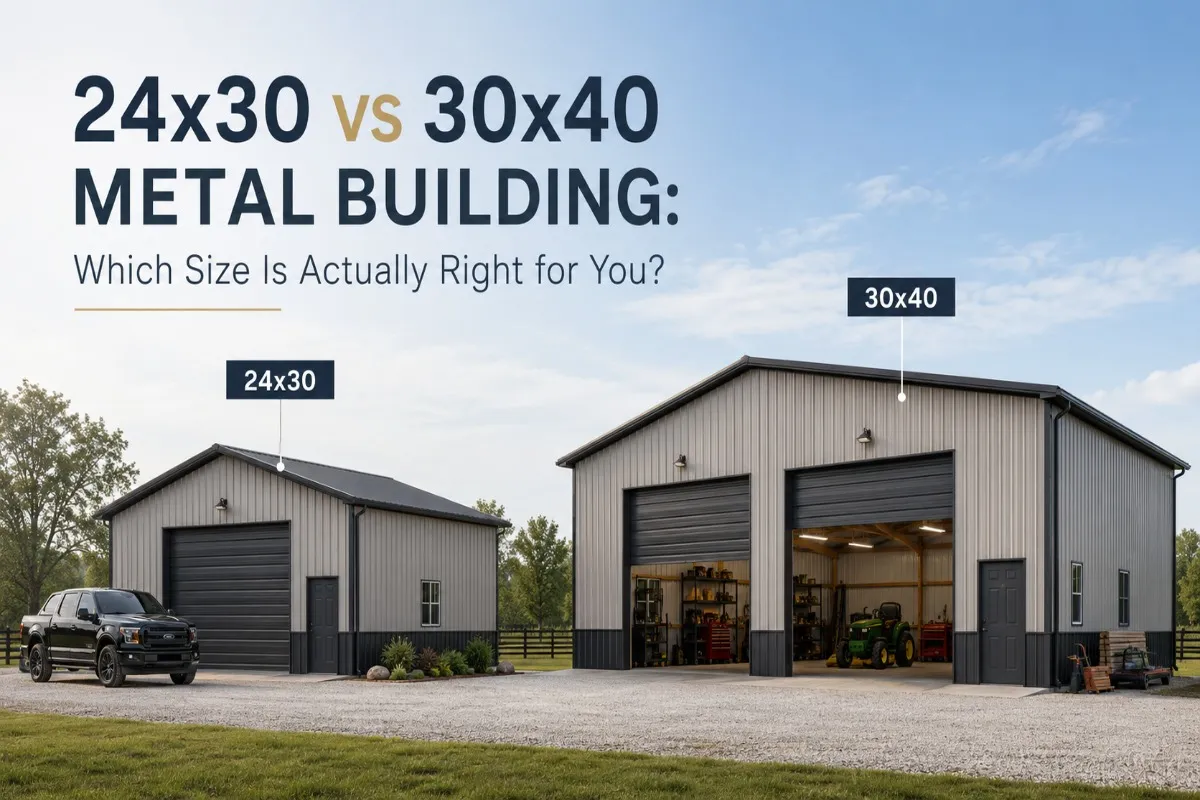
24x30 vs 30x40 Metal Building: Which Size Is Actually Right for You?
 Stephan Michaels
A 24x30 metal building sounds pretty good when you first start shopping.
Thirty feet deep. Twenty-four feet wide. Plenty of room for two cars, right?
And in a clean drawing, it usually looks that way.
Then you start adding the real stuff.
A pickup truck. Maybe an SUV. A mower. A freezer. Wall shelves. A workbench. A rolling toolbox. Some Christmas bins. Maybe a side-by-side later. Maybe a trailer.
That’s when the size choice starts getting harder.
I’ve seen a lot of folks walk into this decision thinking they only need parking space. Then a year later, they’re using the garage for storage, repairs, hobbies, equipment, and weekend projects too.
That’s where the difference between a 24x30 metal building and a 30x40 metal building really shows up.
It’s not just square footage.
It’s how the building feels once you actually use it.
TL;DR: Quick Answer
A 24x30 metal building works well for basic two-car parking, moderate storage, and a small work area. A 30x40 metal building gives you a lot more breathing room for tools, trailers, equipment, shelves, and a real workshop setup. The biggest difference is not just size. It’s usability. The 30x40 gives you more room to move, work, park, and grow into the building later.
What the Size Difference Actually Looks Like
On paper, the numbers are simple.
Building Size | Total Square Feet |
|---|---|
24x30 | 720 sq ft |
30x40 | 1,200 sq ft |
That is a 480 square foot difference.
That sounds like math.
In real use, it feels like a different building.
A 24x30 gives you enough room for two vehicles and some storage if you lay it out carefully. You can fit a small workbench along the back or side wall. You can keep lawn tools, boxes, and a few larger items in there.
But you need to stay organized.
Once things start spreading out, the walking space gets tight.
A 30x40 gives you wider lanes, deeper storage zones, and more separation between parking and working areas. You are not stepping around the mower every time you open a truck door. You are not moving a trailer just to get to a toolbox. You have room to leave a project out overnight.
That last part matters more than people think.
A garage that only works when everything is perfectly cleaned up gets old fast.
With garage building sizes, the extra space is not just for more stuff. It gives you better use of the stuff you already own.
What Fits Inside a 24x30 Metal Building?
A 24x30 metal building is a solid size for a lot of homeowners.
I do not want to make it sound small, because it is not.
At 720 square feet, you can do plenty with it.
A normal 24x30 layout might handle:
Two cars or SUVs
Some wall shelving
A mower or small lawn equipment
A small workbench
A freezer or storage cabinet
Seasonal items along the back wall
For a basic two-car garage, it can work fine.
If you are parking two regular vehicles and storing a few things along the walls, a 24x30 makes sense. It is especially useful when the property does not have a lot of extra room, or when the budget has to stay tighter.
But here is where it gets real.
Two vehicles do not just need floor space.
You need room to open doors. Walk between them. Carry groceries. Pull a trash can through. Get a toolbox around the front bumper. Walk behind a truck with the garage door closed.
That is where 24 feet of width can start feeling snug.
A full-size pickup can run around 80 inches wide without mirrors. Add mirrors, door swing, and walking space, and the width gets used up quickly. Put another SUV beside it, and you can still fit, but you may not love the space between them.
Depth matters too.
Thirty feet sounds deep until you park a long truck in there and add shelves across the back wall.
A crew cab pickup may take up close to 20 feet by itself. Leave room in front. Leave room behind. Now your storage wall starts shrinking.
A 24x30 can also handle a small workshop corner, but I would call it light workshop use.
Think small repairs, basic tools, woodworking on weekends, sharpening blades, working on a mower, maybe a bench with pegboard above it.
It is not the size I would choose if someone plans to build cabinets, rebuild engines, run a small business, or keep multiple projects going at once.
The building can do it.
You just end up moving things more often.
And that is usually what frustrates people later.
What Fits Inside a 30x40 Metal Building?
A 30x40 metal building is where the layout starts to breathe.
At 1,200 square feet, you have enough space to separate the building into zones instead of forcing everything into the same area.
That changes daily use.
A common 30x40 layout might include:
Two vehicles with comfortable door space
A third vehicle, depending on layout
A real workshop area
Storage walls on one or two sides
A mower, ATV, or small tractor
A trailer or business equipment
Toolboxes and workbenches
Room for hobby or project space
This size is popular because it gives people options.
You can park two vehicles and still have a usable shop area. You can keep storage on the side walls without making the middle feel blocked. You can back in a trailer easier. You can set up benches and still walk around them.
The 30-foot width matters a lot.
That extra six feet over a 24-foot-wide building may not sound huge at first. But inside a garage, six feet is a big deal.
That can be the difference between squeezing past a vehicle and walking normally.
It can be the difference between opening both truck doors and only opening one halfway.
It can be the difference between a workbench that stays clear and a workbench that becomes a storage shelf because there is nowhere else to put things.
The extra depth matters too.
Forty feet lets you park long vehicles and still keep a work zone behind them. Or you can keep parking up front and build a shop area in the rear. Some folks use one side for vehicles and the other side for equipment or business storage.
That is why 30x40 works better for hobbyists and small business owners.
It gives you room to change your mind later.
And you probably will.
Side-by-Side Comparison Table
Feature | 24x30 | 30x40 |
|---|---|---|
Vehicle Capacity | Best for 2 standard vehicles | Fits 2 comfortably, 3 with the right layout |
Workshop Space | Small bench or corner setup | Dedicated work area with better movement |
Storage Flexibility | Moderate storage if organized well | Strong storage space along walls or rear |
Workspace Comfort | Can feel tight with vehicles inside | Easier to walk, work, and move equipment |
Future Expansion Room | Limited once full | Better long-term flexibility |
This is the simple version.
A 24x30 works when the building has one main job.
A 30x40 works better when the building needs to do several jobs.
Parking plus storage.
Parking plus workshop.
Workshop plus equipment.
Vehicles plus business use.
That is the real metal building size comparison.
The Real Difference: Workflow and Daily Use
Square footage sells the building.
Workflow decides whether you like using it.
That is what I have seen over and over.
A smaller garage can look perfectly fine when it is empty. Clean concrete. Nice walls. Plenty of open floor.
Then life moves in.
The mower gets parked near the door because it is used every week. Storage bins go along the back wall. The workbench gets covered. A ladder ends up leaning near the side. One vehicle gets parked a little crooked. Now you are walking sideways between things.
That is usually where a 24x30 starts to feel tight.
You can still use it.
But you start moving things before you can do other things.
Move the mower to pull the truck in.
Move the bikes to open the toolbox.
Move the trailer to reach the shelf.
Move the storage bins to use the bench.
That gets old.
In a 30x40, you have more room to leave things where they belong.
That makes a bigger difference than buyers expect.
If you work on vehicles, you need space around the vehicle, not just under it. You need room for a creeper, jack stands, parts, lights, a cart, and maybe another person helping you.
If you do woodworking, you need open space for boards, saws, dust collection, and room to turn around.
If you store equipment, you need room to get equipment in and out without unloading half the garage first.
A 30x40 gives you better aisle space.
That helps with:
Opening vehicle doors
Backing trailers
Walking around workbenches
Moving tool carts
Loading and unloading
Keeping storage separate from work areas
That is why workshop garage sizes need more thought than basic parking sizes.
A parking garage and a working garage are not the same layout.
When a 24x30 Makes Sense
A 24x30 metal building is a good choice when your needs are clear and controlled.
It makes sense if you want:
✔ Standard two-car parking
✔ Moderate storage along the walls
✔ A lower building cost
✔ A smaller footprint on the property
✔ Light workshop use
✔ Space for household overflow
✔ A clean garage without heavy equipment
This size works best for someone who stays organized and does not plan to pile in a lot of large items.
It is also a good fit when the driveway, yard, or setback rules limit the building size.
Not every property can handle a 30x40.
Sometimes a 24x30 is the right answer because it fits the land better.
For basic home use, it can be a smart size.
Two cars. Some shelving. A mower. A bench.
That is a reasonable setup.
Where I get cautious is when a buyer starts saying things like:
“I may add a lift later.”
“I might store a trailer.”
“I want a shop in the back.”
“I may start doing side work.”
“I have a tractor, but it’s small.”
“I’ll probably get a bigger truck later.”
That is when I start leaning bigger.
Because those future plans usually show up sooner than expected.
When a 30x40 Is the Better Choice
A 30x40 metal building is usually the better choice when the garage needs to grow with you.
It makes sense if you want:
✔ A dedicated workshop area
✔ Room for larger trucks or SUVs
✔ Space for trailers or equipment
✔ Better storage without crowding vehicles
✔ A hobby shop or small business setup
✔ More comfortable movement inside
✔ Long-term flexibility
✔ Room for future tools, benches, or machines
This is the size I usually like for people who know they will use the building often.
Not just park and leave.
Use it.
Work in it. Store things in it. Maintain equipment in it. Spend Saturdays inside it.
A 30x40 gives you enough space to build a real layout.
You can put roll-up doors where they make sense. You can plan a walk-in door near the shop area. You can keep the workbench out of the parking lane. You can build storage without losing every inch of open floor.
That is the difference.
The building starts working with you instead of against you.
For steel garage layouts, 30x40 is one of those sizes that gives you a good balance. Big enough to be useful. Not so large that it feels like a commercial warehouse for a homeowner.
It fits a lot of real-world needs.
Ceiling Height Changes Everything
Width and depth get most of the attention.
Wall height gets ignored until it causes a problem.
Do not skip this part.
A 24x30 or 30x40 building with the wrong wall height can still feel limited.
For many garage setups, 10-foot walls are fine. That gives you room for standard vehicles, decent door heights, and normal storage.
But if you have taller trucks, lifted vehicles, RVs, enclosed trailers, or plans for a lift, you need to think harder.
Here is how I usually explain it.
10-foot walls
Good for standard cars, SUVs, pickups, general storage, and normal garage use.
This is fine for many homeowners.
But it may not give enough clearance for tall doors, lifts, or larger recreational vehicles.
12-foot walls
A good middle ground.
Better for taller doors, trucks, trailers, overhead storage, and a more open feel inside.
If someone is unsure and the budget allows it, 12 feet often feels safer than 10.
14-foot walls
This is where you start getting into better clearance for RVs, taller equipment, larger trailers, or serious shop use.
If a lift is part of the plan, you need to match the wall height, roof style, door height, and inside clearance carefully.
Do not guess here.
A lift needs more than “tall walls.” You need usable interior height, roof clearance, door placement, and enough floor space around the lift.
Same thing with an RV.
The RV height on paper is not the only number. You need to consider roof accessories, door clearance, approach angle, and how comfortable you want the opening to be.
This is why I always tell buyers to size for the tallest thing they may own.
Not just the tallest thing they own today.
Common Buyer Mistakes
I have seen a few sizing mistakes repeat for years.
Different customers. Same regrets.
Planning only for today
This is the big one.
A buyer sizes the building around what they own right now.
Two vehicles. A mower. Some boxes.
That sounds simple.
Then they buy a bigger truck. Add a side-by-side. Start working from home. Pick up woodworking. Start storing business materials. Help a family member store a trailer.
Now the garage is full.
Buildings do not stay empty. They collect life.
Plan for that.
Forgetting door swing and walking room
A vehicle fitting inside is not the same as the garage being comfortable.
You need room to open doors, walk around bumpers, unload items, and get between vehicles without rubbing against them.
This matters even more with trucks and SUVs.
A tight garage gets annoying every single day.
Treating storage like an afterthought
Storage eats wall space fast.
Shelves, cabinets, totes, yard tools, ladders, and spare parts all need a home.
If you do not plan storage zones early, storage spreads into the parking area.
Then the whole building feels messy.
Thinking a small workshop corner is enough
Sometimes it is.
Sometimes it is not.
A workbench needs more than the bench itself. You need standing room, tool storage, lighting, power access, and space for the item you are working on.
A 24x30 can hold a small workbench.
A 30x40 can support a much better shop layout.
That is a big difference.
Choosing too small to save money
I understand budget.
Everybody has one.
But saving money by going too small can cost more later. Not always in dollars right away, but in frustration.
You may end up adding a shed, renting storage, parking outside, or replacing the building sooner than planned.
The cheapest size is not always the best value.
The right size is the one you can use without fighting it.
Quick Buyer Checklist
Before choosing between a 24x30 and 30x40, walk through this list.
✔ Number of vehicles planned
✔ Vehicle size checked, including mirrors and door swing
✔ Storage needs considered
✔ Lawn equipment or trailer space planned
✔ Workspace requirements planned
✔ Workbench location chosen
✔ Roll-up door size checked
✔ Door height checked
✔ Wall height matched to future use
✔ Future expansion considered
✔ Property space and setbacks reviewed
✔ Budget compared against long-term use
Do this before you order.
Not after the slab is poured.
FAQs
Is a 24x30 metal building big enough for a workshop?
Yes, but it depends on the kind of workshop.
A 24x30 can handle a small workbench, tool storage, and light repair work. It works best when you are not also trying to store too many large items. If you want a serious shop with saws, tool carts, vehicle work, or business use, a 30x40 will feel much better.
Can a 30x40 metal building fit 3 vehicles?
Yes, a 30x40 can fit 3 vehicles with the right layout.
The type of vehicles matters. Three compact cars are easier than three full-size trucks. Door placement also matters. If you want comfortable parking, storage, and walking room, two vehicles plus a workshop is usually the better use of a 30x40.
Is a 30x40 worth the extra cost?
For many buyers, yes.
The extra space gives you more flexibility, better storage, and a more useful workshop area. If you only need basic two-car parking, a 24x30 may be enough. If you plan to work inside the building or store equipment, the 30x40 usually pays off in daily comfort.
What wall height should I choose?
For basic garage use, 10-foot walls may be enough.
For taller trucks, trailers, better overhead storage, or future flexibility, 12-foot walls are often a better choice. For RVs, lifts, or larger equipment, look at 14-foot walls and make sure the door height and interior clearance match your needs.
Can I add onto the building later?
Sometimes, but it is better to plan the right size from the beginning.
Add-ons depend on the building design, local rules, foundation, roof style, and how the original structure was installed. It is usually cleaner and more cost-effective to size the building properly the first time.
Which size is better for a home garage?
For basic home parking and storage, a 24x30 can work well.
For a home garage that also needs a workshop, equipment storage, hobby space, or room for future vehicles, a 30x40 is usually the safer choice.
Which size is better for small business use?
A 30x40 is usually better for small business use.
Business storage grows quickly. Tools, supplies, equipment, inventory, and work areas all need space. A 24x30 may work for light storage, but it can feel tight once daily work starts happening inside.
What is the biggest difference between 24x30 and 30x40?
The biggest difference is usable space.
A 24x30 can fit the basics. A 30x40 gives you room to move, work, store, and adjust the layout as your needs change. That extra width and depth make the building easier to live with.
Choosing the Size You Won’t Outgrow in Two Years
Here is the plain way I look at it.
Choose a 24x30 metal building if you need a clean, practical two-car garage with some storage and light work space.
It is a good size when the building has a simple job.
Choose a 30x40 metal building if you want the garage to do more.
More tools. More equipment. More movement. More storage. More future use.
That extra space matters because most people do not use their garage exactly the way they imagined on day one. Life changes. Vehicles change. Hobbies grow. Tools multiply. Storage always seems to find a way in.
A good metal building size comparison should not just ask what fits.
It should ask how the building will feel after two years of real use.
That is where 30x40 usually wins.
Not for every buyer.
But for the buyer who wants a workshop, storage, and room to grow, it is the size that causes fewer regrets.
Garage Buildings helps buyers design custom metal buildings nationwide, including garage and workshop layouts based on real vehicle sizes, door needs, wall height, storage plans, and future use. The right building is not always the biggest one.
It is the one you will still be glad you bought after it is full.
About Stephan Michaels
Stephan Michaels is the founder and owner of GarageBuildings.com, a company he started more than 25 years ago—quite literally from his own garage. What began as a small operation has grown into one of the largest tubular steel building dealerships in the United States. GarageBuildings.com remains proudly family-owned and operated, with family at the heart of its success. Stephan’s mother has served as office manager for over two decades, his sister Charlotte oversees daily sales and operations, his niece Kayla leads the accounting department, and his daughter Ellie is part of the sales team. Together, they have built a business rooted in trust, dedication, and long-standing relationships. Stephan and his team are committed to providing a transparent, positive experience for every customer and partner. Their continued growth and strong reputation are driven largely by customer referrals and the confidence people place in their work every day.