
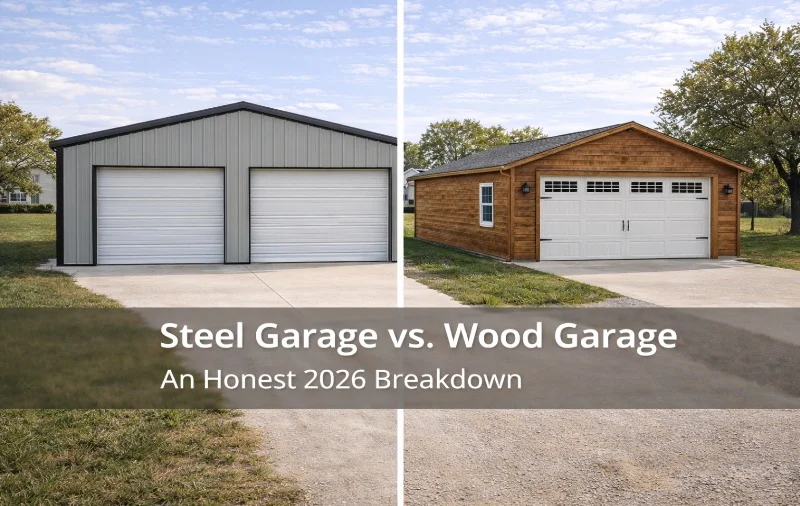
Steel Garage vs. Wood Garage: An Honest 2026 Breakdown
 Stephan Michaels
 TL;DR
In 2026, steel garages offer an unparalleled value, starting at $6,999 delivered and installed. In contrast, a comparable site-built wood garage typically ranges from $18,000 to $28,000 before considering ongoing maintenance costs like repainting every few years, pest control, and roof replacement around year 12. Over a 15-year period, homeowners may spend an additional $20,000 to $50,000 more on wood garages compared to their steel counterparts.
While wood may be preferable for those facing HOA restrictions, owning a historic property, or desiring a finished bonus room above the garage, the financial benefits of steel garages are increasingly compelling. The choice is clear for the average homeowner in 2026.
Why the Cost Gap Between Steel and Wood Is Expanding in 2026
The gap in costs between steel and wood garages has widened significantly in recent years. While wood was already costly, manageable labor costs and stabilizing lumber prices seemed promising five years ago. Today, the landscape has shifted dramatically.
As we approach 2026, framing lumber prices are hovering around $850 to $900 per thousand board feet, marking a nearly 17% increase year-over-year. Additionally, U.S. tariffs on Canadian softwood lumber, currently ranging from 14% to 21%, are compounding expenses for every stick-built project across the nation. Contractors in the Southeast and Midwest are now quoting wood garage builds at prices that would have seemed outrageous just a few years ago.
Conversely, steel prices have remained relatively stable. Domestic production has kept standard gauge building steel prices in check, and the prefab model—where your garage components are manufactured and shipped directly—significantly reduces labor costs that have been inflating wood garage budgets.
If you based your estimates on data from 2021 or 2022, it's time for a reality check. The pricing dynamics have shifted dramatically, so make sure to consult current numbers before making a decision—refer to the table below for the latest insights.
Real Cost Comparison
Many articles on this topic focus solely on the upfront purchase price, which is a narrow view. A garage is a significant long-term investment, and the total cost of ownership—including purchase price, maintenance, and lost time—is what truly matters.
Upfront Cost by Size (2026 — Delivered & Installed)
Garage Size / Use | Prefab Steel — Delivered + Installed | Site-Built Wood — Materials + Labor (2026) |
|---|---|---|
12×20 — single car | From $6,999* | $12,000 – $18,000 |
$3,500 – $10,000* | $18,000 – $28,000 | |
30×40 — large enclosed / workshop | ~$16,000* | $45,000 – $65,000+ |
40×60+ — commercial / multi-use | $25,000 – $45,000+* | $80,000 – $120,000+ |
* Accessories and local wind/snow load requirements may affect final cost. Concrete slab not included.
The 15-Year Total Cost of Ownership — 24×30 Size
This is where the comparison becomes pivotal. Wood’s disadvantage extends beyond the initial purchase price—it encompasses every dollar spent on maintenance over the next 15 years.
Cost Category | Prefab Steel Garage | Site-Built Wood Garage |
|---|---|---|
Purchase + installation | $8,000 – $14,000 | $28,000 – $42,000 |
Exterior repainting (every 3–5 yrs) | $0 — factory finish | $1,500 – $4,500 over 15 yrs |
Roof maintenance / replacement | $200 – $400 (bolts + touch-up) | $3,500 – $8,000 (yr 12–15) |
Pest control — termite regions | $0 | $2,000 – $6,000+ over 15 yrs |
Rot / warp / structural repairs | $0 | $800 – $4,000 (climate-dependent) |
Insurance savings — steel discount | $750 – $2,250 saved over 15 yrs | $0 discount |
Estimated 15-Year Total Cost | $8,500 – $16,000 | $35,000 – $66,000+ |
The difference is stark—anywhere from $20,000 to $50,000 over 15 years for a mid-size garage. This stark contrast illustrates why the decision has shifted decisively toward steel. The initial premium for a wood build does not yield returns in aesthetics, resale value, or performance; it simply results in higher expenses.
Durability: What to Expect Based on Your Climate
Claims about lifespan without context are mere marketing. A steel garage in Louisiana faces entirely different conditions than one in high-desert Colorado. Here’s what you need to know about each major U.S. climate zone and how it affects your material choice.
Snow Belt — Montana, Minnesota, Upstate New York, Pennsylvania, Ohio
Snow load is the primary concern in these regions, and steel excels when designed correctly. A vertical roof steel garage—where the panels are oriented perpendicular to the ridge—effectively sheds snow instead of accumulating it. This distinction is crucial in areas prone to heavy snowfall. If a supplier quotes you a regular roof building for regions that frequently experience 24+ inch snow events, be sure to request vertical roof certification.
Wood garages can also handle snow loads, but budget-friendly builds often under-specify the truss system for the span width. The issues may not arise immediately; they typically manifest after several years, particularly following two consecutive harsh winters, when ridge deflection becomes evident. Proper structural engineering is essential.
About Stephan Michaels
Stephan Michaels is the founder and owner of GarageBuildings.com, a company he started more than 25 years ago—quite literally from his own garage. What began as a small operation has grown into one of the largest tubular steel building dealerships in the United States. GarageBuildings.com remains proudly family-owned and operated, with family at the heart of its success. Stephan’s mother has served as office manager for over two decades, his sister Charlotte oversees daily sales and operations, his niece Kayla leads the accounting department, and his daughter Ellie is part of the sales team. Together, they have built a business rooted in trust, dedication, and long-standing relationships. Stephan and his team are committed to providing a transparent, positive experience for every customer and partner. Their continued growth and strong reputation are driven largely by customer referrals and the confidence people place in their work every day.